The Twilight Period
I can hear the howls...

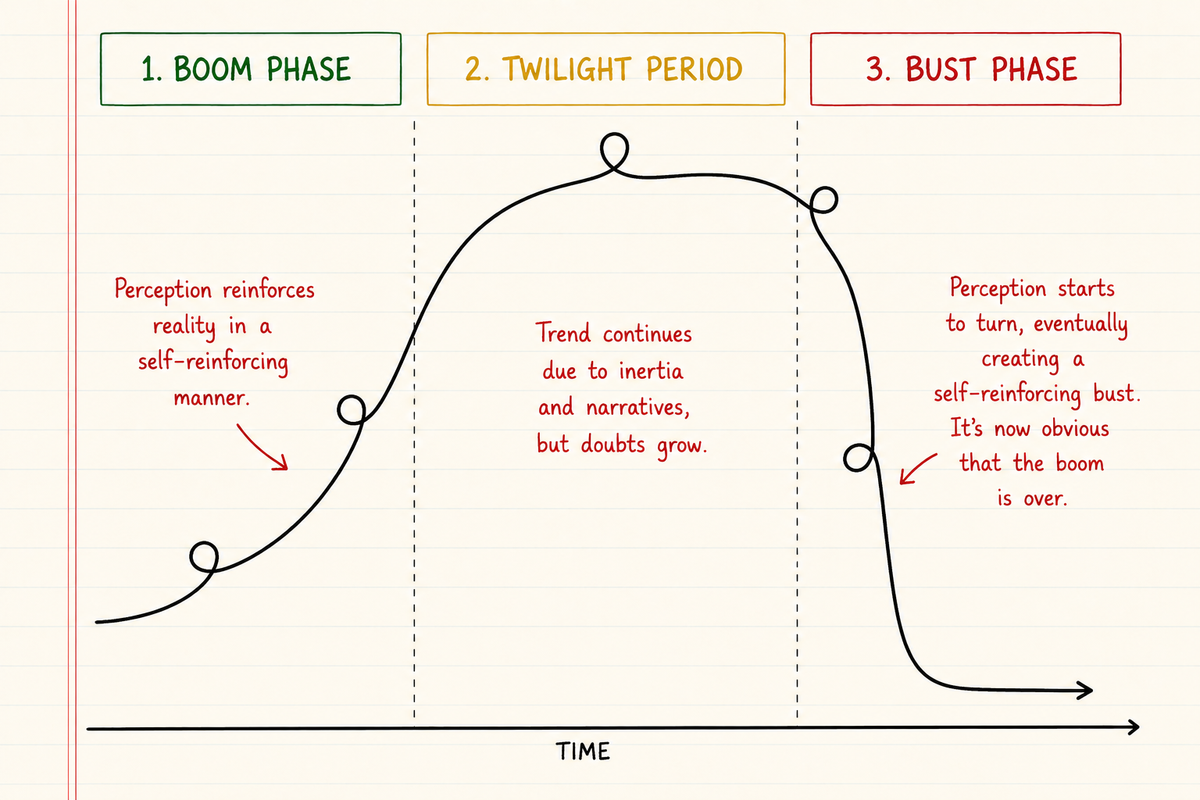
Eventually, market expectations become so far removed from reality that people are forced to recognise that a misconception is involved. A twilight period ensues during which doubts grow and more people lose faith, but the prevailing trend is sustained by inertia... Eventually, a point is reached when the trend is reversed, it then becomes self-reinforcing in the opposite direction.
Boom–bust processes tend to be asymmetrical: booms are slow to develop and take a long time to become unsustainable, busts tend to be more abrupt, due to forced liquidation of unsustainable positions and the asymmetries introduced by leverage.
— George Soros
...Are we in the Twilight Period for AI?
The narrative is already in retreat – while pockets of the market are not at all.
The picks and shovels trade is still strong, extrapolating a present that is, in my view, too bold and optimistic.
The market is taking for granted the promises of Big AI – that their AI-related capex will be ever-increasing.
It's easy to fall into the trap: they gush out tons of cash, have pristine balance sheets and can raise capital at will: Google showed that with its $80bln raise.
The collective group of companies that we refer to as Big Tech/AI has simply never existed before. This is why attempts at drawing historical comparisons like the 1999 cycle are non-applicable, at best.
I did touch on Confirmation-Bias Investing in Sell the IPO? last week: Rationalising backwards to make a narrative fit while rejecting any alternative scenarios.
...Now let's pick up where we left off in that piece 🔻
Current State of AI
After this section we will explain why a correction will probably sow the seeds of the bust...
PAY ATTENTION!
I don't say this lightly. If you brush this off, you will probably end up like the people who brushed off my bearish pieces on Crypto.
Here's a list of realities and dynamics emerging that will feed the reversal narrative of the cycle – after it gains enough momentum, the reversal will become self-reinforcing.
- On the picks and shovels side, deals are being signed, but not being delivered
- AI aims to solve problems using brute force and ever more compute
- But it's becoming obvious that elegance is the way – not brute force
- The upcoming OpenAI and Anthropic IPOs are distorting reality, all for the IPO
- Old Mantra: Consume compute at all costs
- New Mantra: Consume compute to create value
- "Cost is the ultimate differentiator." -Philo
- No-blow-out quarters result in sharp sell-offs
- Hyperscaler stocks have paused and reversed
- Only picks and shovels are up, as they are seen as the next / current bottleneck
- AI darlings such as Palantir are losing the market's interest and selling off
...But what happens to the AI trade as a whole when there is no next bottleneck?
...When compute supply is more than demand and when Compute Merchants can't even make a profit?
Citadel's Tokenomics – Philo's take 🦉
Citadel published a piece this week titled Tokenomics. The gist of the short piece aligns with what we've been saying for some time now...
That cost is the ultimate differentiator – and that broad adoption of AI technology (models etc.) will rely on their cost to serve.
In their piece, Citadel refers to Amazon stepping back from their token leaderboard – which pushed for higher token usage to no avail, and Microsoft cancelling their Claude Code arrangement. Finally, they mention the Token Bill Armageddon, i.e. firms losing control of their AI token bills and having to do something about it...
Again, cost is the ultimate differentiator. Citadel argues that AI will bifurcate between frontier and everyday models.
I agree. But there are several second-order effects that could prove far more important for market outcomes.
Before we get to that, let me quote Citadel first 👇
Economic theory tells us that prices perform three basic functions: they signal scarcity, create incentives for substitution, and ration scarce resources toward their highest-value uses. These functions apply clearly to AI.
Higher compute and inference costs signal the scarcity of the underlying inputs; they encourage substitution away from low-return experiments and toward more efficient models or workflows; and they ration scarce capacity toward the areas where the marginal productivity of AI justifies the marginal cost of using it.
We do not think this implies that the frontier of inference-intensive AI will be abandoned, only that it is likely to be concentrated among a narrower set of firms with the balance sheets to absorb the compute cost, the research depth to deploy it effectively, and, most importantly, the operating domain to scale the rewards from solving genuinely hard problems.
For the economy at large, simpler models may be the more cost-effective, productivity-augmenting pathway until physical constraints are eased. We hence see growing signs of a bifurcation in frontier vs “everyday” AI usage.
From: https://www.citadelsecurities.com/news-and-insights/global-macro-strategy/tokenomics/
Citadel references the Silicon Data LLM Expenditure Index, which shows a doubling of the price per million tokens, since December '25.
AI Cost Sensitivity
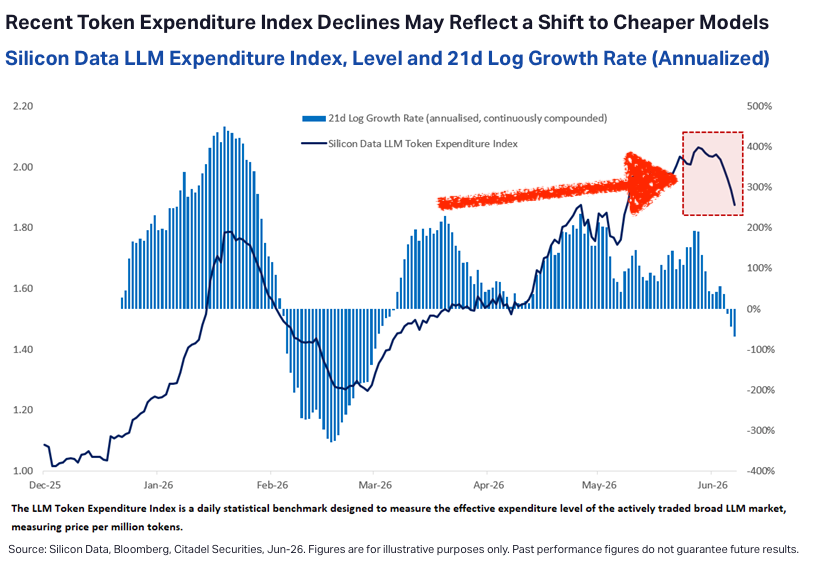
Assuming the index is a good enough proxy for price per million tokens, and without getting too technical, we can understand that models have been getting more expensive to serve. The red arrow on the chart indicates where this is reversing as users are trading down.
Now let's look into what this means for the broader AI supply chain.