The Central Bank of Nvidia, Part #3
RIP Data Center.


"My optimism is tempered by the insight that the time when past excesses are corrected is the period of greatest risk.
Moreover, the process of correction can develop its own momentum, setting off a self-reinforcing trend in the opposite direction."
–George Soros
This is the third part of The Central Bank of Nvidia series.
In this part we look at what happens when the economics of the AI boom start to unravel – and when things turn from a positive-feedback loop to a negative one.
What complicates the setup even further is the emergence of a new layer in the cycle. What was once a positive force is now becoming a headwind.
These are the two opposing sides:
The AI industry (Big Tech/AI etc.) – and those that benefit from "more AI" on one side.
And the People, as represented by The State, on the other.
The problem is that the latter does not have a clear role.
On the one hand, it needs more AI to boost the economy and spread the wealth effect. On the other, it needs the people on its side.
I expect this bifurcation to get more attention and become more relevant going forward. When it's time – we will dedicate a whole article to this matter alone.
Only a few months ago the White House was backing the Stargate project and throwing around numbers as high as $500bln. Now Trump is saying data centres should pay a dividend to communities for support.
Regardless of the fact that neither Stargate nor the dividend are true – this idea matters to AI.
Central Bank of Nvidia
In Part #1 we introduced the first three layers of the boom/bust process – and explained the importance of Nvidia in the cycle.
Layer 1: Inception of the process
Layer 2: The Hyperscalers, and the Valuation -Vs- ROI game
Layer 3: Nvidia-as-a-Catalyst (NaaC)
Nvidia created a loop, an infinite-money glitch if you will, where the more money it made – the more money it made.
And of course, it took it too far... 🪃
Its influence in AI was so great that it managed to skew reality. And others tried to understand AI, using that skewed reality to make decisions according to it.
Part 2 extends the argument beyond the Hyperscalers and into the emerging Neocloud industry.
And introduces the concepts of the Nvidia Put, and OpenAI as the Subprime Lender of the whole process.
In Part #3 we expand on this layer.
Layer 4: Nvidia supports and funds Neoclouds (like CoreWeave) – fuelling equity and debt leverage, and amplifying the process.
Layer 5: Charter-backed / GPU-backed finance
Compute merchants started using their GPUs as collateral to borrow more money – and buy more GPUs.
The idea of GPU scarcity started to emerge, primarily as a rationalisation for their business practices. If GPUs were scarce and valuable, and the debt was backed by the GPUs, then there was no risk. That seemed to be the idea.
Technologists and the broader market supported this – focusing on some bulletproof upside while completely ignoring the risks.
And Nvidia wasn't just a passive seller of those GPUs – they signed offtake agreements* with those Neoclouds to guarantee a buyer for all that excess compute.
Nvidia became both seller and buyer. Crazy.
*Charter-backed finance, where the charter was collateral for the loan.
Layer 6: Nvidia enables these providers through access to its technology and ecosystem, strengthening their ability to secure contracts, attract investment, and expand capacity. Some sort of twisted Nvidia-backed nepotism.
The whole process relied on Compute Providers (Neoclouds, Hyperscalers etc.) being able to borrow cheap money while boasting sky-high valuations.
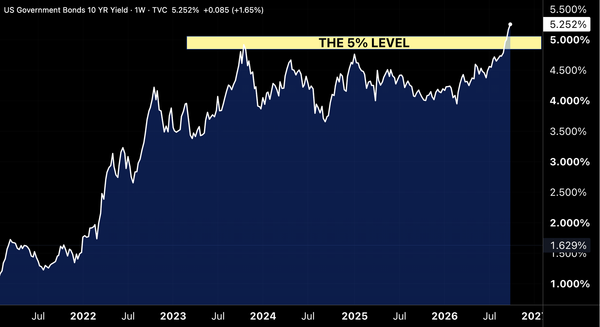
Now, this benign environment has already started to reverse 🔄🔻
"But there is a flaw: How much value does Al really create?"