LaaS: Layoffs-as-a-Service
When AI Turns from Tailwind to Headwind

The launch of ChatGPT and its explosive growth in users has been the key catalyst of this AI-driven cycle, ever since its inception in late 2022. At the same time, the importance and effects of the cycle on the broader economy has to be taken into consideration.
In fact, the AI cycle was the main reason why rate hikes by the Fed didn’t cause an economic slowdown. With post-Covid deficits by both Biden and Trump also aiding the economy — in classic Keynesian deficit-spending fashion.
Now the process is maturing and past the early stages in its life cycle. We mapped out the boom/bust process in a piece from 2024 — using Sorosian boom/bust analysis to understand the process as well as its flaws. Seeing the process and the simple cause and effect is easy — seeing the flaws of the process is another thing.
1) The Tailwind: AI Capex
Those who bet on the “picks and shovels” trade of AI were vindicated as Big Tech and VC both went all in on AI.

NVDA returned a 17X since the bottom of late ‘22 — when markets were focused on the Fed’s rate hiking cycle. If you need some context to position yourself: that’s where the AI Cycle started.
And in simple terms it can be explained as: more GPUs —> more Revenue —> higher valuations and more (assumed or expected) Value Creation.
In our Techno-Imperial Cycle piece we framed the major flaw of the cycle as 👇
How much value does AI really create?
The Bust 🔄
The cycle is starting to reverse.
The first hit was Oracle and their terrible OpenAI RPO deal — with the sharp reversal of their share price. We wrote about this in Wake Up Call!
As marginal development in AI is tapering — expectations of AI’s effect on the real economy are accelerating. Refer to the recent software stock selloff as an example.
On that vertical, we published a thought piece to touch on a few misplaced narratives that we see the market adopting.
 Philoinvestor
Technological Determinism & AGI
(Excerpt from Low Hanging Compute)
Technologists tend to fall into these intellectual traps. Like economists believe in market fundamentalism, and geneticists (and others) believe in genetic determinism,so do technologists believe in technological determinism.
Technological determinism is the idea that technological progress will inevitably supersede human labor and judgment — a sort of technological inevitability.
Artificial General Intelligence (AGI) is fundamentally a technologically deterministic idea.
(Excerpt end)
The debate on the relationship between Compute and Intelligence is ongoing — and we see it as just a continuation of the debate on AI Capex spend and ROI.
The answers to both will become clear after the dust has settled and everything is said and done.
Having discussed the broader issue both with technologists and finance bois — I find that the former doesn’t get it while the latter doesn’t want to get it.
Philo’s Thoughts 🦉💭
First, the market adopted the narrative that AI capex results in value creation — bidding up all layers in the AI stack. But the jury is still out on whether this massive capex spend will result in lasting value creation for every layer.
We published AI Tech Playbook to discuss and differentiate between each layer in the stack. This is where you can form opinions on the economics of AI Labs, Semiconductor Companies, Hyperscalers, the Application Layer etc.
Philoinvestor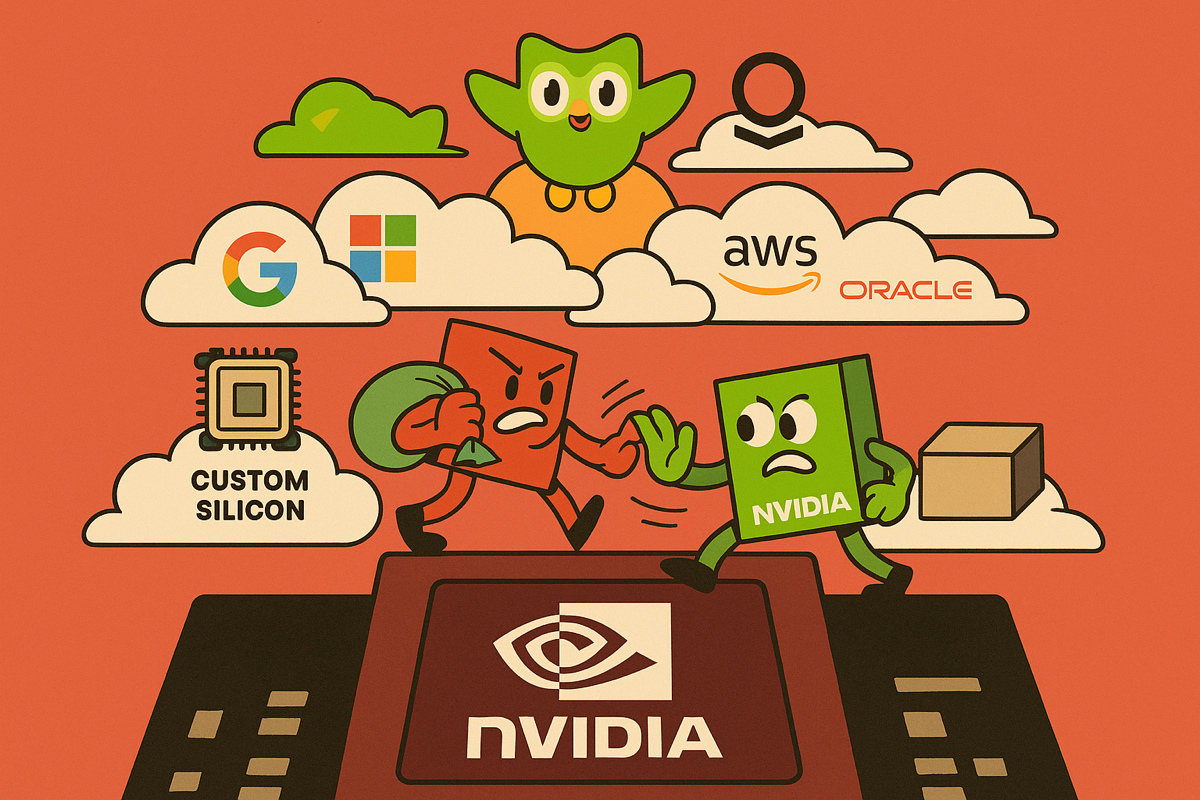
Second, the market is adopting the narrative that the “Cost of Intelligence” is deflating fast — soon to be worth zero. The adoption of this narrative by the market is the stock crash of every company considered to be under threat from AI proliferation.

The Race is STILL On
But putting aside the complicated dynamics and relationships in play — let’s now discuss the relationship between the existential need for Big AI to continue spending in AI Capex — and how that forces them to change their business models.
Note: when I say AI Capex I mean both tangible capex (e.g. Data Centers) and intangible capex (e.g. Training LLMs).
Now the mass-layoff lever is growing with rumours of Oracle, Google and Amazon about to fire tens of thousands.
Information on their objectives suggests they were planning this for a long time — realising that their balance sheets could not sustain both unhinged spending on AI and a bloated workforce.

2) The Headwind: Mass Layoffs and AI Hybrid
While the AI Capex buildup story was economy positive — mass layoffs is massively economy negative.
These mass layoffs intend to serve a number of aims: psychological, economical but also to change reported economics (accounting) and shift cash from humans to AI.
We will touch on all of these layers in this piece.
Note: mass layoffs and cooking the books to overstate AI-led productivity will both boomerang in the face of Big AI. Please allow me to explain because there’s a lot happening here.
These are the levers Big AI can pull to continue playing the AI game — and try to stay ahead (or not stay behind!).
- Shift their business model from labour centric to AI centric — you can call it AI Hybrid. This flattens the organisational structure, allowing Big AI to fire tens of thousands across the board, drastically cutting costs in the process.
- The risk of this is that the whole company’s (e.g. Amazon) software shifts from human oriented to AI oriented. There are already reports that Amazon software is breaking down because of this fast shift. Employees are not happy.
- This objective could also be the reason why Amazon is investing so massively in Anthropic. Because besides the valuation gains it hopes to make — it expects to extract productivity gains/savings by using Claude across their operations. These gains are more immediate and tangible, at least P&L wise..
- By cutting costs that flow through P&L — you get an immediate expansion in reported margins. This keeps the narrative going and shareholders happy.
- This allows Big AI Management to continue burning cash on AI Capex (that gets capitalised) — because it doesn’t flow through the P&L. It only hits Cash Flow.
- At the same time, Big AI itself can preach “productivity gains” from AI. They become the proof themselves!
- But the reason they are firing humans is not because AI is so great, it’s because AI is so expensive! And as we’ve been saying for long — this is an existential race for them.
- Besides the obvious consequence that Cash Flow gets decimated in this process — with Net Income relative to Free Cash Flow getting more diverged than ever.
- We also have AI-led fragility accumulating in the system. As more and more “code” deployed is AI generated. Then which human is able to debug that when something happens? The value of code is not just in writing it — it’s in managing and maintaining it. Boomerang incoming 🪃
The above explains the first lever Big AI is pulling to prolong the AI Hype: Fire people and spend more on AI Capex. Not to mention that they employ more accounting tricks to capitalise more costs that should go through the P&L, in an attempt to cook the books.
In addition, Big AI uses another accounting “trick” to cook the books even further. And that’s pivoting the compensation of their human employees more to share-based compensation (non-cash) and away from actual salaries (cash) — to retain cash and cook their cash flow statements. Again, accounting trickery.
Then they turn around and use that excess cash to repurchase shares from the open market. Either way, cash flow still gets decimated.
The Reflexive Connection 🔄
Phase 1: The AI Capex Cycle was not only stimulating to the economy — it also reinforced the AI Cycle. Capital flowed into AI in all forms. Picks and shovels, subsidised compute, funding AI-related startups, you name it.
All that money created a different reality — a reality that would not have existed were it not for all that capital. That reality corroborated AI narratives, reinforcing the cycle in the process. That’s reflexivity.
Phase 2: Big AI is now resorting to mass lay-offs to continue the AI Capex Cycle — but at a major cost, employment. Millions will be laid off globally for cost-cutting and in an attempt to prove that AI-led productivity gains are real.
This is negative to the economy — that same economy, which when it was booming, generated the profits that Big AI used to fund their AI capex.
In a recession, how much will advertising spend drop? What about retail spending?
And how much will that affect the business of Meta, Google and Amazon? Right around the time when their balance sheets are over-extended and they are fiercely competing between themselves. i.e. The commoditisation of AI argument.
It’s all a big intractable mess. The take-home is that the AI Cycle was economy positive in a self-reinforcing way and it could now turn economy negative, again in a self-reinforcing way!
Self-reinforcing to the downside, that is.
The Passive Layer
But let’s not ignore the effects of Passive Investing on market structure.
It seems to me that this AI Cycle has been allowed to exist for as long as it has — simply because investors don’t do any work anymore.
I view the markets as fundamentally broken. Passive investors have no opinion about value. They’re going to assume everybody else has done the work.
—David Einhorn
But for how long will Passive accept near-zero FCF on their holdings? How will they react when their holdings start selling off with no natural buyers stepping in to stem to drop?
This layer complicates the setup even further. Years ago we first explained that “The ROI is in the Valuations”.
The cycle is now reversing and when valuations reflect that more seriously — where will the ROI be then?
Won’t the market turn around and say that all this Capex cycle was mostly an AGI crusade — that has mostly led to trillions in malinvestment?
Malinvestment refers to investments, capital allocation, or expenditures that are misguided, unprofitable, or wasteful, typically resulting from distorted price signals during an economic boom.
In this case, it has been an AI boom with subsidised compute, self-funded demand and government backing of the whole process — under the banner of an overall race for AI supremacy.
Philo 🦉