Currency Debasement for Dummies: On Real Assets
3 Equity Cycles

We’ve clarified our rules on individual subscriptions, institutional access, and intellectual property.
We’re expanding institutional licensing, with individually negotiated arrangements for organisations seeking multi-user access, internal research distribution, and AI-powered access to our research.
On the last day of the year we sent out Currency Debasement for Dummies: On Silver.
Silver was amidst a huge bull market that took it from $20 to $120 within two years. There are always reasons for (violent) market moves – some real, some made up.
 Philoinvestor
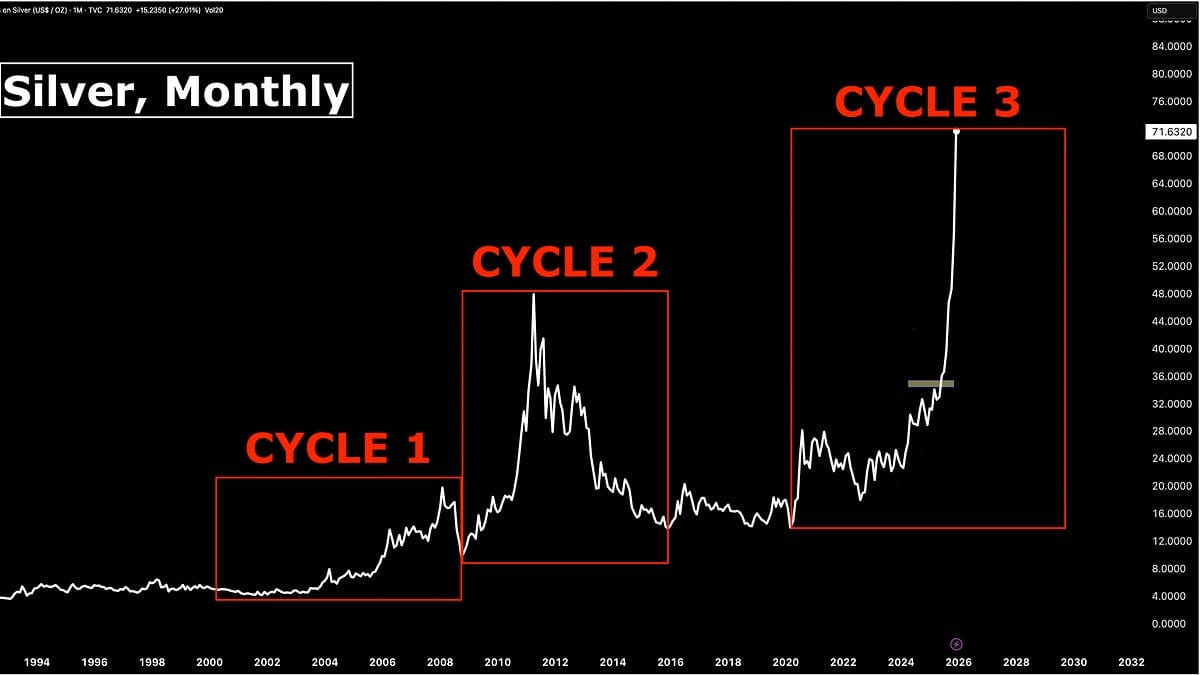
In the letter: We cautioned against further Silver bullishness and explicitly warned of a single-day drop of 20-30% on a subsequent Philochat.
We concluded the letter with an extreme call.
"If so, Silver could correct by 60-70% taking it back down to $33 or even $25."
The outcome: On January 30th, Silver dropped 40% from open to lows of the day. Silver is now at $49 – not far from hitting our target.
The time is now ripe to publish another piece in the Currency Debasement for Dummies series.
On Real Assets
The argument for real assets is that currencies are being debased and your purchasing power is being eroded.
Buying a bond at $100 par means you are expected to get that principal back on maturity. But what if that $100 is worth less on maturity?
That's inflation risk – or currency debasement risk.
Short Inflation
Inflation means your money is losing value as it's being debased away (let's just use Dollars).
And so any investment whose return is quoted in a fixed number of dollars returned to you, makes you effectively short inflation.
Do you want to be short inflation when inflation risks are to the upside? And for a measly return? I don't.
Long Equities
The equity of a good business is denominated in currency (e.g. dollars).
But its return is not directly tied to a fixed number of dollars returned to you in the future – as in the case of bonds.
But that doesn't mean you're marked safe from everything – and are expected to just print returns going forward. Things are rarely that linear.
And things you can't control like luck or randomness.
Often things we understand as skill, are just luck, and vice versa.
The lines between the two are blurry. The technologist who went all in on tech stocks and made a killing will tell you that it was all skill. He knew everything that was going to happen. That's his claim and view.
The generalist investor assessing his returns will tell him that the range of outcomes was extremely wide when he made the allocations – and that the environment and multiple expansion can explain away most of his returns. Not his stock selection.

Case in point: AI wonder boi, Leopold Aschenbrenner, of Situational Awareness fame.
Leopold's fund has already blown up in spectacular fashion – not due to randomness or bad luck, but purely because of stupidity.
Yet half the market still considers him an investor with unique skills that did not deserve this outcome – and that he will absolutely bounce back stronger...
Big Picture: Historical Context
Before we come to the present – let's zoom out and get some historical perspective.
You can't understand the present without understanding the past that led us here.
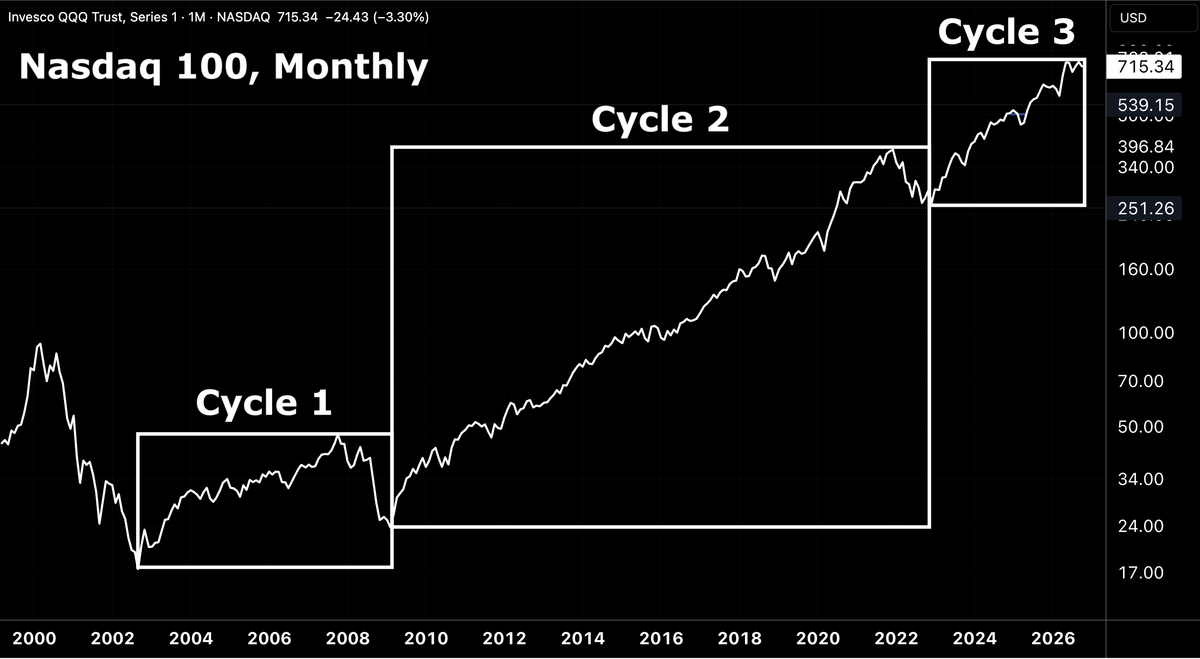
Let's break the past 23 years into three major cycles.
Cycle 1: 2003 to 2009
Cycle 2: 2009 to 2022
Cycle 3: 2022+
Through this cycle analysis: We will see how risk/reward, optionality, markets and investing in general have transformed and shifted.
We will use these insights to get a better understanding of what the future holds for equity investing.