No Ram. No Story.
Won Moon? 🇰🇷

"No risk, no story." -Unknown
Markets are closed on Monday for Memorial Day. The long weekend makes it a "perfect" time for a resumption of the war in Iran.
The Kentucky Primary is also out of the way — an important checkpoint for the Trump Dynasty.
Since March, memory stocks have staged massive rallies under the narrative that memory is the next (and current) bottleneck of ever-increasing AI workloads.
Besides adoption and proliferation of AI, these ever-increasing AI workloads are a function of AI models getting bigger and costlier.
Narrative Follows Price
This memory bull market has caused many participants to invent and theorise the non-cyclicality of memory stocks in an AI world.
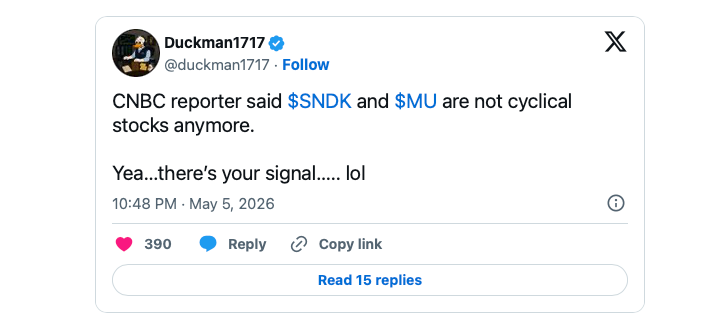
This is basically the narrative...
- Memory is no longer about Smartphones and PCs...
- Memory isn’t boring anymore – memory is cool
- Memory is what will take us to AGI
- Compute is intelligence and we can never have enough intelligence
- Memory is the last bottleneck in the infinite AI buildout cycle
- Memory is not a commodity...
Demand for compute is INSATIABLE — models will get better and better, context windows will ever-expand, man.
Infinite memory demand is just the logical conclusion to all this, and someone has to build it.
Look at their stocks! Are the people bidding up these stocks, stupid? No they are not, you’re stupid!
To be fair, technological advancements in AI enabled by Semis and yes, memory — have resulted in the killer application of AI.
And this is the application that is soaking up most of the compute and memory needs out there. Besides training the models themselves of course!
(Vibe) Coding
First off, building software is not just an AI spitting out words on a screen. It's much more complicated than that. I thought Brandon here summed it up nicely 🔻

Coding with AI is really software engineering, debugging, large context windows, frontier models, agents checking, verifying, running – fetching data and so on...
Coding and other AI workloads are now consuming copious amount of memory. And this insatiable demand for memory has made memory manufacturers very very wealthy.
And where are the two biggest memory giants in the world located? South Korea
Take a look at the KOSPI — it’s up 3X since April '25 (Tariff Tantrum) 🔻
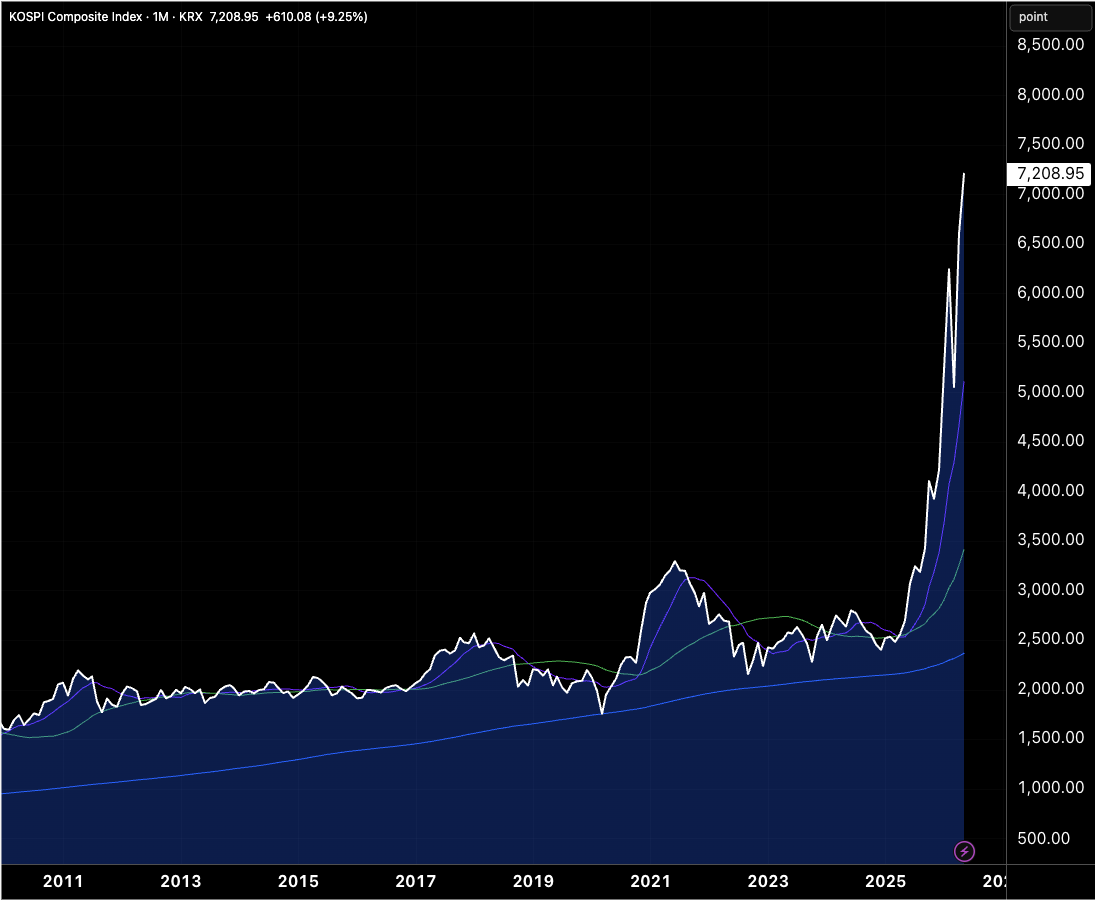
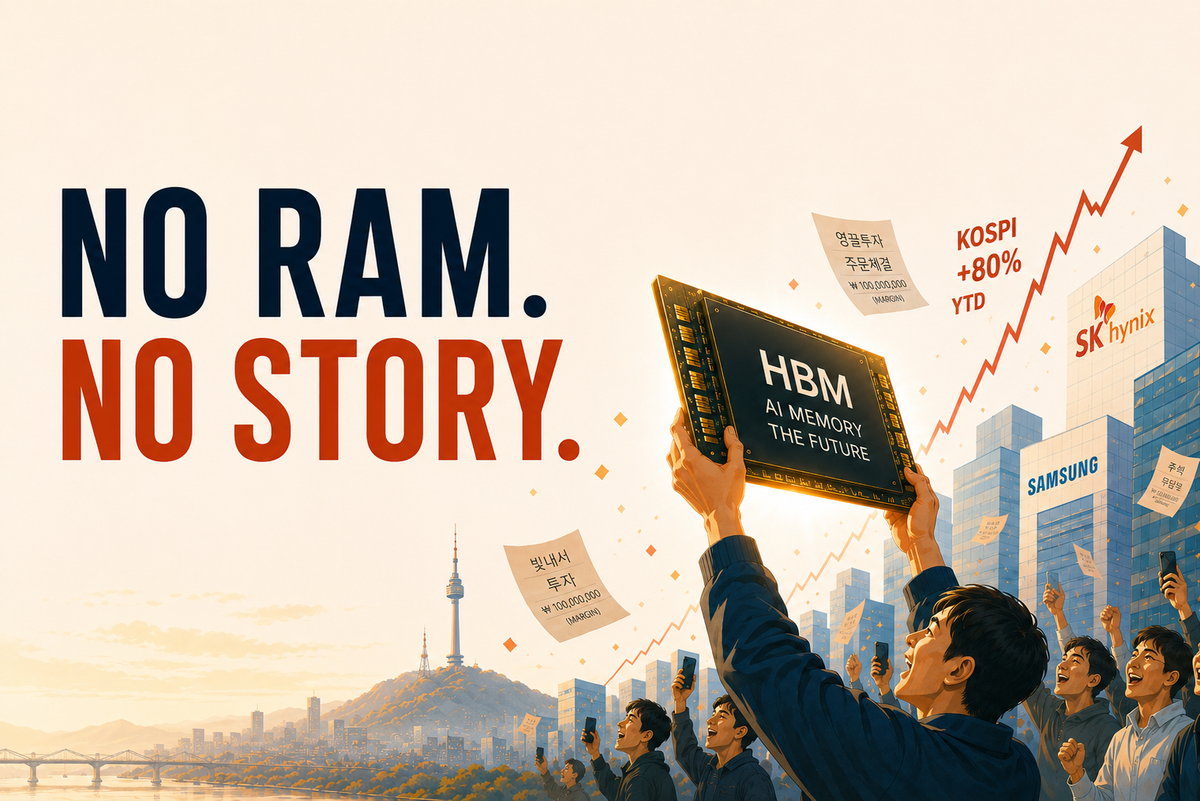
This price action in SK's two memory giants, Samsung and SK Hynix, has created a sort of rush to buy Memory stocks. Koreans are buying up shares like never before — and on margin.
But this is not your typical garden variety bubble with no substance. These companies are actually printing money.
Here's an excerpt from Micron Technology's blowout quarter.
“Micron set new records across revenue, gross margin, EPS, and free cash flow in fiscal Q2, driven by a strong demand environment, tight industry supply, and our strong execution, and we expect significant records again in fiscal Q3,” said Sanjay Mehrotra, Chairman, President and CEO of Micron Technology.
- Strong demand and lack of supply ✅
“In the AI era, memory has become a strategic asset for our customers, and we are investing in our global manufacturing footprint to support their growing demand. Reflecting confidence in the sustained strength of our business, our board has approved a 30% increase in our quarterly dividend.”
- Strategic asset narrative ✅
- Investing to support growing demand... ✅✅✅
For the quarter, Micron Technology generated sales of $24bln and EBIT of $16bln (Margin of 66%).
For Q3 they guide revenue of $33.5bln, gross margins of 81% (up from 75%) and diluted EPS of $19. Diluted EPS for Q2 was $12.
For context, this is a $725 stock as of now. Annualising Q3's EPS of $19, MU is currently selling for less than 10X earnings.
But the devil is in the details...
Capital Expenditure 🔥
Half their Q2 presentation was about expanding supply to meet this insatiable demand for memory...
- We expect fiscal 2026 capex to be above $25 billion
- We project our fiscal 2027 capex to step up meaningfully to support
HBM and DRAM-related investments. - We expect construction-related capex to increase by over $10 billion year-over-year in fiscal 2027 as we build out our global manufacturing sites to address long-term demand opportunities.
- In addition, we expect higher equipment spend year-over-year in fiscal 2027.
- As we make these investments, we will continue to be responsive to the market environment and our customer demand to appropriately align our supply plans... 😂
Ok, I added the emoji.
It's clear that Micron (but also the other memory giants) are expanding their capacity – and this is costing them billions in capex.
To put it into perspective....