Opec Infighting: Trojan Horse
The UAE Trojan Horse

The UAE is no longer in OPEC...
The UAE was OPEC's fourth biggest producer with ~3mln bpd out of a total ~25mln. Significant but not fatal, that's the first thought.
But there is a story beyond the numbers, and that's the important one. This move by the UAE sets the stage for what is to come in Gulf politics – and widens the rift between the Emirates and the Kingdom of Saudi Arabia.
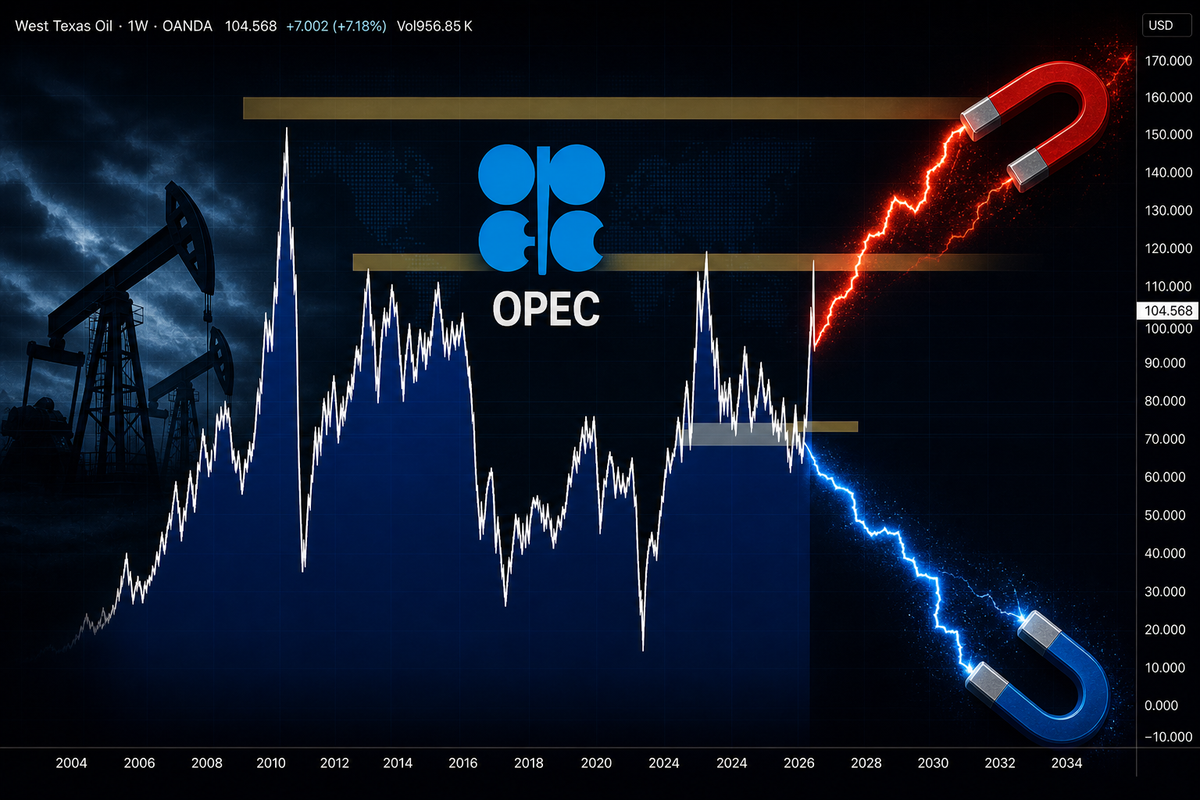
Last year we published Opec Infighting to discuss the setup for Oil – and explained why the supply curve was, in fact, inverted.
Since then, crude lingered until the Iranian war kicked off, causing its price to swiftly more than double. On April 8th, all parties to the war agreed to a ceasefire and the war has been on pause since – but boiling under the surface.
...George Soros would say that the oil market is in far-from equilibrium territory.
The less philosophical of us (and more practical) would just say that above-average volatility is to be expected for oil going forward.
In fact, I could see a scenario for both $20 Oil.. and $200 Oil. But not to worry, the money isn't made in the research or the prediction – the money is made in how you trade it. 🦉🙏
"Research finds the opportunities, but it's the trading that makes the money." –Philo
In many ways, the big-picture dynamics pushing the price of oil down outlined in last year's Opec Infighting still hold. It's just that the events around the Gulf have put that dynamic on ice.
Despite that, the damage to the energy-industrial complex of the Gulf has been material – and economic confidence has also taken a hit. Iran decided to pull the rug under the feet of every single American Base Gulf country, and take everyone down with them. UAE, Saudi, Qatar, Oman, Kuwait, Bahrain...
Their first move was to neutralise all American Bases in the area and remove the ability of the US to strike them going forward. Any attacks to their energy-industrial infrastructure would be met with equal or greater attacks against the equivalent infrastructure of their neighbouring countries.
That move practically put the whole world hostage – and signalled that, "If we are struck, you are going down with us."
Suddenly, the Gulf understood that their future existence (and prosperity) is no longer a guarantee. Putting that at risk was out of the question for the Sheikhs and Princes of the area.
But Gulf Monarchies are not a monolith, they lie on a spectrum. Each Monarchy has different ultimate goals, and different cards to play with and different realities to deal with.
Saudi has walked a tight rope during this conflict, choosing its words carefully and always looking to de-escalate. Besides, the Kingdom knows (and has known for time) that it cannot fully rely on the US anymore. It has been forced to open diplomatic channels with Iran – in a broader understanding of co-existence.
The Saudis know Iran can wipe out their energy infrastructure any moment, or more simply, close the Strait of Hormuz rendering them unable to export their product. No product means no money; and no money means the Saudi mega projects are officially dead.
On the other hand, the UAE has no choice who they work with. The Emirates are a signatory to the Abraham Accords and work closely with the Americans and the Israelis. In fact, the broader rift between Saudi and the UAE is because the latter no longer want to play second fiddle to the former. And their path to Gulf hegemony goes through the Americans and the Israelis.
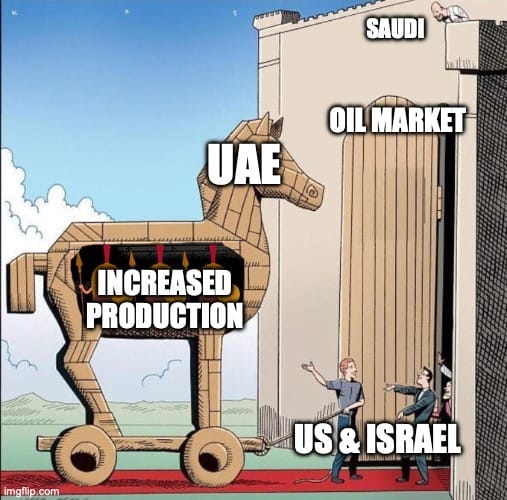
For the Saudis, that is simply unacceptable. The Saudis, in an attempt to self-preservation, chose diplomacy. But the rift between the UAE and the Saudis is becoming more and more clear – with a schism opening between an Abrahamic Gulf and an Islamic Gulf.
For the Emiratis, considering their long-term objectives, the next move was to double down. This exit from Opec is an expression of that doubling down.
The UAE's exit from Opec is a historic event; future moves in oil will also be historic. Let's look into the probable scenaria for how this plays out.
The Forces in Play 🧲⚡️
Before we move on to the possible scenaria, and in an attempt to map out the territory and trade any market that unfolds – let's list the forces in play.